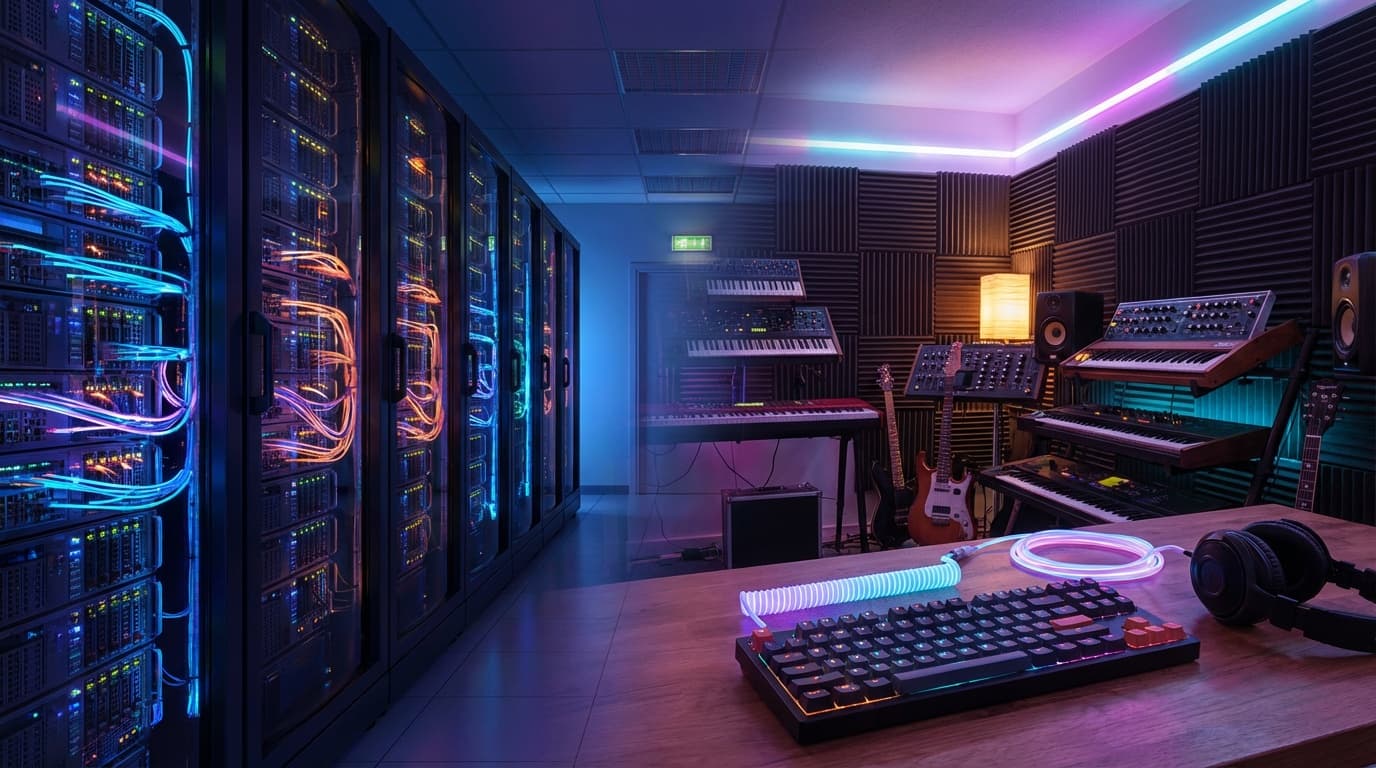
I have a running hypothesis about the future of software that I cannot unsee anymore.
Software splits into two durable classes.
One class gets more complex over time because it accumulates data and workflows. Think Notion or any system of record that sits in the middle of your work for years. The other class is almost the opposite: it exists to make you feel something, for a moment, and it can be built cheaply. It is moodware.
Everything in the middle will get thinner. Most productivity apps that are not systems of record can be vibe-coded at low cost. They will look fine, they will ship fast, and then they will vanish.
That leaves us with two extremes, and a platform-shaped gap between them.
The split I cannot unsee
I used to think there was a smooth spectrum of software: simple utilities on one end, complex enterprise tools on the other. I no longer think that is how this era plays out.
I think the shape is now more like a barbell.
- One end is heavy, compounding, and sticky.
- The other end is light, expressive, and disposable.
The middle becomes unstable because the cost to build a decent middle app keeps falling. When the baseline becomes cheap, only the extremes are defensible.
This is not a moral judgment. It is an economic one. If you can create an app with a few prompts, the only way it survives is if it becomes essential or if it becomes loved.
Systems of record keep compounding
Systems of record are the software that people move into and then do not want to move out of. Notion is a good public example, but the same logic holds for accounting systems, CRMs, clinical records, research repositories, even your personal knowledge base.
Their gravity comes from three things:
- Data compounding: the longer you use it, the more you store and the harder it is to leave.
- Workflow coupling: you build muscle memory, automations, and team rituals around it.
- Shared trust: the system becomes the place where the "truth" of your work is kept.
These products are expensive to build because they must handle edge cases and scale. They are expensive to change because they hold real history. They are not easily vibe-coded. They are long games.
That is why this class will keep getting more complex, not less.
Moodware: software that feels good to use
The other end is what I call moodware: software whose main job is to create a feeling.
I bought a tiny app recently for 5 dollars: klack. It adds mechanical keyboard sounds while I type on my Mac. That is it. It does not improve my output. It changes my mood.
And it worked. I used it for a week. It made me smile. It did not need to be perfect. It needed to be delightful.
Moodware is not new. We have always had small apps that are toys, rituals, or aesthetic boosters. What is new is how cheap they are to make and distribute. They now show up everywhere.
They also tend to be short lived. You use them, get the feeling, and move on.

The disappearing middle and cheap vibe coding
Most mid-tier productivity software used to survive by being "good enough." It solved a specific problem for a narrow audience. That used to be a business.
Now, those apps are getting squeezed from both sides:
- The system-of-record products keep expanding and absorbing features.
- The moodware products keep spawning new, cheaper alternatives.
Meanwhile the cost to build a decent productivity app keeps falling. Vibe coding makes it easy to build a template, bolt on an API, and ship a working UI. This pushes the middle into a commodity zone.
So what happens to the middle?
It becomes either a feature inside a system of record, or a short-lived moodware experiment that dies after a season.
That is a harsh view, but I think it is where the economics point.
Disposable software and the calendar of life
The moodware side is more interesting than it sounds. It creates a new category of software that is intentionally temporary.
Think about one-time or short-cycle software:
- A party app for a single event.
- A focused diet plan for a 6-week window.
- A personal productivity sprint for exam season.
- A seasonal habit tracker that only matters in winter.
This is not "bad" software. It is software that is aligned with life cycles. Its job is to heighten a moment, not archive it forever.
Once you accept that, you build differently. You care about onboarding, mood, and social sharing more than long-term retention. You care about a clean exit as much as a clean start.
Remix is the new feature
Moodware also has a structural problem: it is hard to hold attention for long without changing the experience.
That makes remixing the core loop. I already want it with klack. I want to add more mechanical keyboard sound packs. I want other people to upload their own and let me switch them in a click.
In systems of record, stability is the feature. In moodware, variation is the feature.
That implies a different architecture:
- Modular components that can be swapped.
- Clear licensing so people can share and remix safely.
- A format for packs, presets, and skins.
When the product is the feeling, the remix is the longevity.
A platform for remixable software
This is where the platform-shaped gap becomes obvious.
If the world produces millions of small, short-lived apps, we need infrastructure that is not tied to any single one. A platform that makes remixing easy and distribution normal.
I imagine a platform with these defaults:
- A unified account and identity layer that travels between apps.
- A distribution layer that makes tiny apps discoverable, not buried.
- A remix layer where people can fork and remix without friction.
- A permissions layer so remixing respects authorship and provenance.
That platform is not exactly an app store. It is closer to a creative network for software. Think of it as GitHub meets TikTok for small apps: easy to remix, easy to share, and tuned for short bursts of attention.
We already have some pieces: app stores, template marketplaces, open-source repos, and no-code communities. But none of them are optimized for the moodware lifecycle.
Business model: charge for gravity, not glue
The business models split too.
For systems of record, you charge for gravity:
- data volume
- security and compliance
- integrations and reliability
For moodware, you charge for glue:
- a small price to try a feeling
- optional packs, skins, or sound sets
- a tip jar for creators
The middle used to charge for "features." That story is fading. Features are easy to copy. Gravity and feeling are not.
This is why the next platforms will focus on distribution and remix. They will monetize flow rather than functionality.
What I would build differently
If I were building in this future, I would ask a different first question:
"Is this a system of record, or is this moodware?"
That question changes everything:
- How long is the product supposed to live?
- Does the data compound, or does the feeling fade?
- Do you optimize for stability or for remixability?
- Is the exit path a bug or a feature?
Most teams will still aim for the middle out of habit. I think that is a mistake. If you are not building a system of record, then you are probably building moodware, even if you do not call it that.
Once you accept it, the design becomes clearer. You can be honest about the lifecycle. You can build for the moment, and still treat the moment as real.

Closing thought
My guess is that the future of software will feel more like music: a few deep catalogs that people live inside, and a long tail of tracks that are played once and remixed forever. If that is true, the platform that wins is the one that treats remix as a first-class citizen, not a hack.